
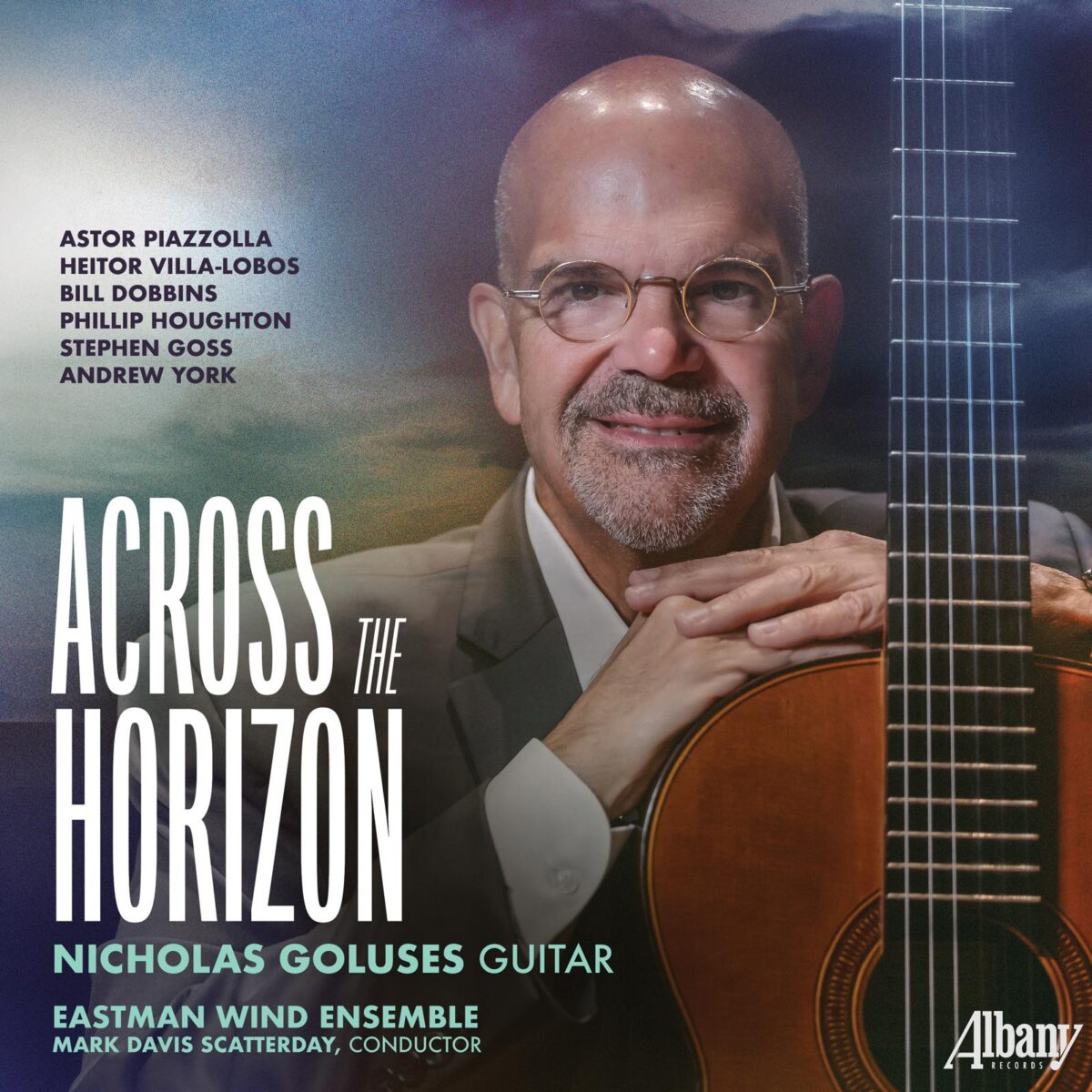
REVIEW: “Across The Horizon” by Nicholas Goluses
Who would you think the most prolific composer of guitar music is? If you said Johann Sebastian Bach, you’d be right! Despite there being no proof that Bach ever wrote for the lute, Bach dominates the classical guitar catalogue through transcriptions and arrangements.
You would struggle to find a conservatory that would let in a guitarist without some amount of Bach repertoire. This is a small example of the weight that dead, centuries-old composers have on the classical music world.
Nicholas Goluses seeks to go against this stigma by featuring exclusively 20th and 21st-century composers in his new album, “Across the Horizon.”
Goluses is Professor of Guitar at the Eastman School of Music in Rochester, NY. He is as renowned as a pedagogue as he is a performer, as shown by his Eisenhart Award for Excellence in Teaching.
Though he often displays his prowess in performing J. S. Bach and Fernando Sor pieces, his solo programs almost always include modern works, shining a light on the living composers who keep guitar music alive. An Eastman concert program from this January says, “Committed to performing new music for the guitar, Goluses has given
world première performances of more than 100 works, including solo pieces, concertos for guitar and orchestra, as well as chamber music by many of today’s leading composers.”
“Across the Horizon” eases the classical guitar listener into these lesser-known, modern works with more recognizable names like Astor Piazzolla (1921 – 1992) and Heitor Villa-Lobos (1887 – 1959). Both of these composers must have had some affinity for the number five, as Goluses plays Piazzolla’s “Cinco Piezas para Guitarra” and Villa-Lobos’ “Five Preludes.” Each set left me satisfied, only with critiques that lean too much towards personal preference to include in this review.
Piazzolla asks the performer to not only learn and interpret his music, but to understand and project to the audience the concept of nuevo tango, Piazzolla’s famous fusion of Argentinian tango, jazz, and classical music. I find Goluses’ interpretation of these five pieces quite in this lane of this understanding; he never sacrifices the groove for virtuous rubato, thereby forcing me to tap my foot and bob my head through each of these lively pieces. To that end, none of the pieces feel metronomic; Goluses found this sweet spot that all guitarists aspire to in his recordings.
The Villa-Lobos preludes are the most recognizable out of these two, as they are very often played, though I thoroughly enjoyed Goluses’ renditions of each. I have even played many of these pieces myself, and though I’ve interpreted them differently, I commend Nicholas’s clarity. You can clearly hear every note in each chord; no one pitch is obscured by another, which proves to be a difficult task for even professional musicians like Goluses. If anything, I would have liked less rubato in the first prelude, as, in contrast to Piazzolla, I would lose the pulse in his interpretation. He makes up for this in almost every other way, though, and I’m glad to have analyzed this alternate rendition.
Bill Dobbins’ piece, “Fantasia,” christens this album with its first living composer. A colleague of Goluses at Eastman (retired in 2022), Dobbins served as a Professor Emeritus of Jazz Studies and Contemporary Media. He wrote and dedicated this piece to Goluses, with this album being the piece’s premiere recording.
As you would expect, “Fantasia” juxtaposes the Villa-Lobos preludes with a heavy jazz influence. Nicholas writes about the work in his program notes, “I asked [Dobbins] for a solo work, and he wrote this superb piece, which has three distinct sections with cadenzas linking each section. The work is infused with sophisticated harmony, elegant melodies, and complex rhythms.”
You can truly feel the camaraderie in both the composition and the performance of the piece. The gorgeous harmony is perfectly complemented in Goluses’ playing, as he brings emphasis to the “head” of the composition, while taking the cadenzas to be free and lean into the more faux-improvisatory nature of them.
“Stélé,” a four-movement solo work by Australian composer Phillip Houghton (1954-2017), is based on Greek mythos and storytelling style, with the title referencing the stone tablets that depict or describe these legends as headstones of heroes and sailors. This piece perfectly complements Goluses’ playing style and use of time manipulation. With a more cinematic, story-rich piece, rubato holds much more weight, and the recording shows how true that sentiment stands. By using space between phrases, Goluses punctuates each idea and gives each note the love and attention it needs.
The heart of this album is the world premiere of “A Concerto of Colours” by Welsh composer Stephen Goss. Nicholas Goluses joins the Eastman Wind Ensemble as a soloist for this colossal fifteen-minute work. He demonstrates his ability to aptly blend with a large ensemble, a task nearly impossible for an instrument as quiet as a nylon string guitar. Of course, volume levels were adjusted for each instrument, but nevertheless, Nicholas’ playing pierced through the texture as if it were a full-staff grand piano. Stephen Goss’ orchestration prowess is partially to thank for this effect as well, as the louder sections of the ensemble back off when the guitar plays quietly or uses harmonics, a technique that is extremely difficult to project.
“Home,” by Grammy-winning composer Andrew York, is the beautiful whisper that this album closes on. “This program represents a voyage across several continents. The works are all linked by a vision by each composer to create a soundscape through the guitar,” says Stephen Goluses, which makes this York piece perfect for a closer; we’ve just traveled around the world in the modern age, and we end by returning home, wherever that may be. The tenderness with which Goluses executes this piece is fantastic and potentially my favorite recording of this collection. Though the triplets throughout could be felt stronger than they were, the interpretation allows for variation and less weight on rhythmic precision. Similar to a sigh of relief after a long, eventful day, “Home” places a quiet period on this brilliant journey of guitar music.
If this album seems interesting to you, it is available on all streaming platforms! Give it a listen and please continue to support classical music in Western New York!
The program from the live performance can be found here: https://www.esm.rochester.edu/uploads/09.29.25-FAS-Nicholas-Goluses-guitar.pdf
