
The Art Of Staying Sharp / Jonathan Lambert – Interview
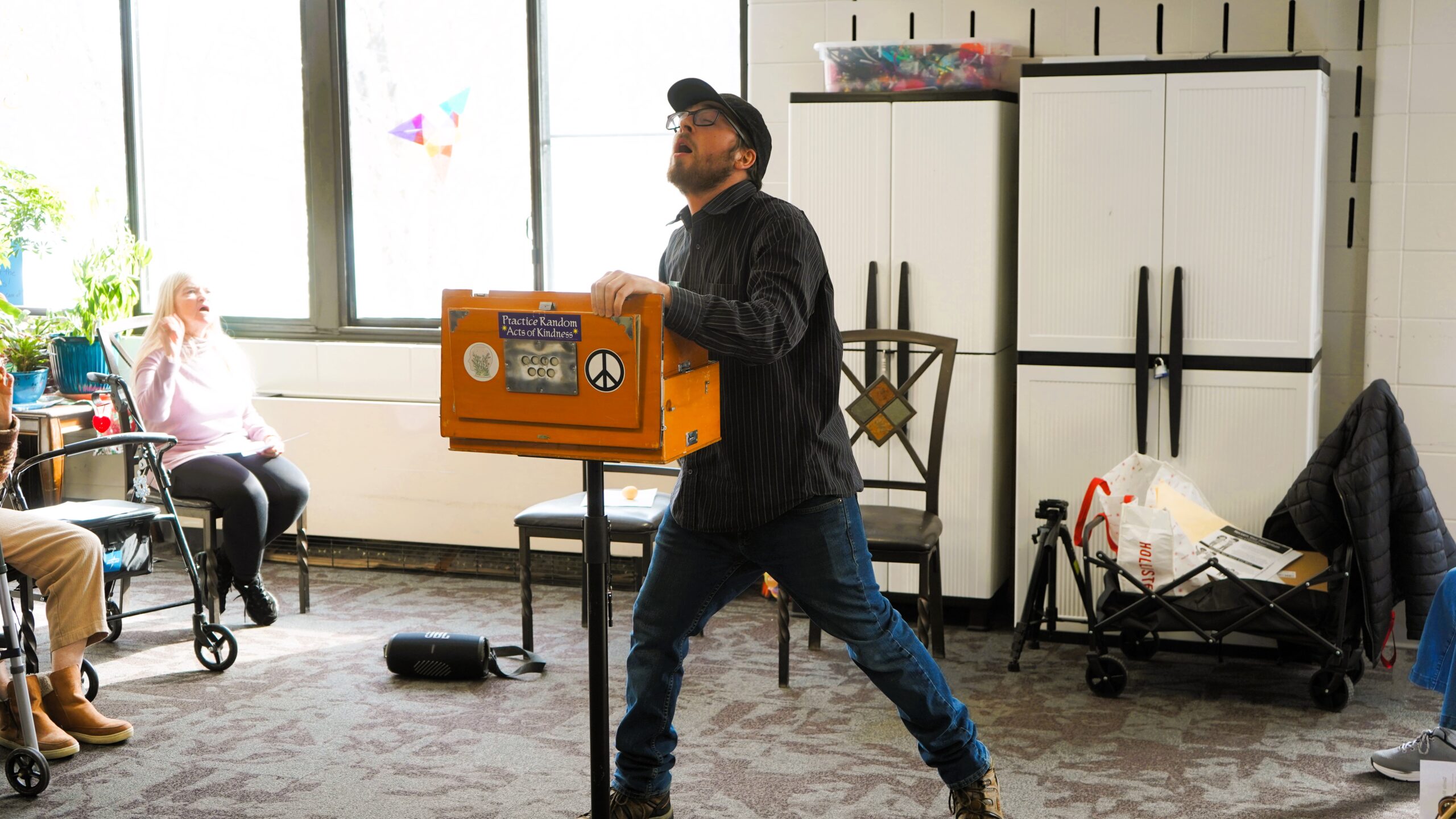
[Jonathan Lambert is a musician, documentarian, photographer, and now, spiritual therapist. He had a large presence in the Buffalo/Rochester metal scene until a period of solitude, hiking in Colorado during his early twenties. Lambert would go on to receive guidance in Bhakti Yoga and the musical meditations of Kirtan. With his harmonium, he now serves the Buffalo community in assisted living facilities, relieving the anxiety and loneliness of its residents.]
WNYMusic:
Hello, Jonathan, and thank you for your openness in collaborating with WNYMusic.com! We’re very interested in not only your journey to get where you are, but where you’re headed with The Art Of Staying Sharp. To get right into it, your initial background was in the metal genre; could you go into how you redirected from such a bombastic combination of electric guitars and cymbals to instruments like the harmonium and the tongue drum? This is an incredible pivot in proficiencies.
Lambert:
It’s my pleasure, and I truly appreciate the opportunity to speak with you about my journey. You’re absolutely right about my roots; I was deeply steeped in the Buffalo/Rochester underground metal community for years. Throughout my teens and early adulthood, that scene was my entire world. Whether I was performing as a guitarist, podcasting with musicians, organizing my annual music festival, or working on my DIY documentaries, Between Exultation and Aggression, it was my way of finding strength and coping with the world through a creative lens. For nearly a decade, it was a healthy, yet consuming, addiction—a “misfit family” where many of my deepest friendships remain to this day.
The shift from aggressive guitars to facilitating Kirtan with the harmonium felt like a destined next stage. For a while, I had been observing my grandfather, who is bed-ridden, lose his “spirit” while moving in and out of assisted living facilities. Seeing that decline had a profound impact on me. I’d actually owned a harmonium for some time, but I had never found the courage to sing with others.
I remember seeing Adam Bauer lead a Kirtan for the first time; I was floored. I realized that the challenge of being that vulnerable for the sake of communal healing was exactly what I, and perhaps society, needed. At its core, metal is about pushing boundaries, but after years of covering every creative base in that genre, I hit a wall.
That’s when I discovered Ikigai—the intersection of what you love, what you’re good at, what the world needs, and what you can be paid for. I realized I was missing a vital link: the drive to serve. My soul was starving for something else, and once I came to that conclusion, there was no other way to move forward. It was as if the world was telling me my path had changed.
WNYMusic:
Throughout your transitioning from “metal to mantras,” you mention the wide range of influences that you’ve had: practices like Kirtan and Bhakti Yoga from Hinduism, the Japanese philosophy of Ikegai, or even your grandfather’s philosophy to entertain. Could you talk to us a bit about the benefits of this combination?
Lambert:
The wide range of influences I’ve embraced—from Kirtan and Bhakti Yoga to the Japanese philosophy of Ikigai and my grandfather’s legacy of public speaking—all share a single, powerful thread: a devotion to serving those around us. The primary benefit of this combination is a yearning to look at our time on earth through a different lens and really uncover what truly matters. I spent quite some time trying to “seek” the meaning of my life, and at various points, it nearly drove me nuts as I struggled to fit society’s mold of the “right way to live.” I’ve always been a thinker, driven to question every aspect of existence.
Throughout my twenties, I sought out long conversations with Buddhist monks, psychologists, devotional singers, and creatives to gather their perspectives on the human experience. I balanced these dialogues with long periods of introspection in the mountains of Colorado and New Hampshire, living out of my rusty van and hiking. The silence of that time, combined with having no “real” plan, led me to some unique contemplations that I never would have found in a more structured life.
A major breakthrough on this journey was signing up for a 10-day Vipassana retreat. Sitting in silence for ten days, eating vegetarian food, and observing the body through constant scans allowed me to notice just how subtle the mind truly is. That experience was a massive turning point, pushing me deeper into the realization of what truly matters and firmly placing me on this path of “metal to mantras.”
WNYMusic:
I noticed on your new website, www.theartofstayingsharp.com, that in addition to your Kirtan services, you also provide the service of “death doula.” You mention there that many people find the topic of death difficult; could you touch on this a bit? More specifically, how does the spiritual education that you have received aid in this service?
Lambert:
Regarding how my spiritual education aids in this service: there was an understanding when I was getting into the work that death would enter my journey at some point. It’s just that recently I’ve realized that the spiritual strength I’ve cultivated is exactly what allows me to offer that support to others.
Last week, I accidentally walked into the wrong room at an assisted living facility and was welcomed by a family giving aid and love to their dying family member (stating that she’d probably only have 24 hours left). They asked me to sit down and have a coffee, and then asked, “What is that wooden box?”
I explained that I’d been on this interesting journey for the last month visiting facilities and described it as a tool for “healing.” That was when it “clicked” that my spiritual path had prepared me for this journey as a death doula and funeral music offerer. Through that lens, the sound unmistakably had become more a celebration of life—a beautiful bridge for the dying’s next journey and a tool for strength to give to the family.
I’d always admired the harmonium for its sound, calling it the most powerful and unique instrument on earth. It’s only recently that others could have the same feeling.
I’d say I’ve gotten close to death various times in my life with car accidents and have felt a sense of understanding that our life on earth is limited. My spiritual education and recent certifications have really solidified to me that this is a legitimate “need” in society and what I’m doing is beneficial for me and those around me.
My education has given me the knowledge of how powerful music is in our final stages of life; it’s given me clear direction and guidelines of what the role is, and how the death-positive movement is a thing.
If I’d really dig deep into it, it taught me what a “good death” entails and how I can help others through that process.
WNYMusic:
Talking to you has been a great exploration of the spiritual power of music, I’m truly grateful for your collaboration with us! To wrap things up, I wanted to allow you to act as a guide to the readers; how can people get involved in making these kinds of changes, either within themselves or within their community? And please feel free to let us know where we can contact you for your services!
Lambert:
It has been an absolute honor exploring the spiritual power of music with you, Luke. I am truly grateful for this collaboration as well! For the readers looking to ignite that same spark within themselves or their communities, here is how you can begin making those changes.
Ultimately, positive change comes down to following your heart. When you do, the universe tends to lead you down the right path. Whether you are a painter, a public speaker, a filmmaker, or an athlete, do everything you can to learn, question, and fully embrace every aspect of your craft. If you are passionate about something, lean into it. Spend the endless hours screwing up and trying again. While you can’t always “infuse” traits like determination or leadership, you can certainly give it a “college try” through sheer persistence.
My biggest piece of advice is that if you see a problem in society, do not stay silent. Use your voice and your actions to make a difference. If you are persistent at learning a new skill—much like my own journey with a camera—things naturally get easier after a decade of using the tools.
Prioritize experiences over materialism and take the time to study minimalism. Put yourself in uncomfortable situations and talk to people you normally would never talk to, because that is exactly where you learn the most. Aim to be the most curious person in the room. Lastly, make a weekly group with your friends to check in on mental health; that is a huge step toward real change.


